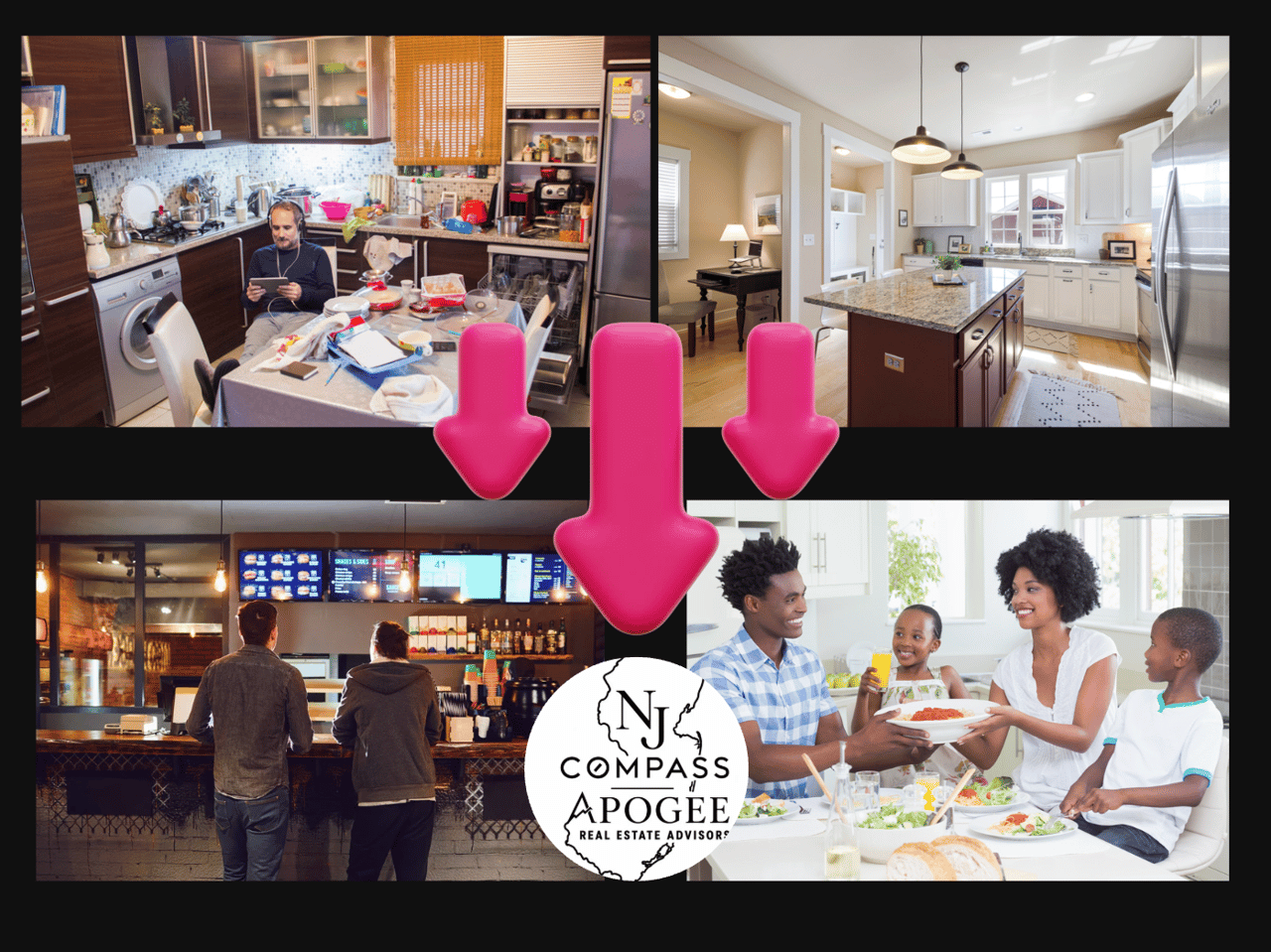
A Calm Kitchen Might Be the Secret to Healthier Habits
Does a cluttered kitchen actually affect what your family eats? Yes. Research on decision fatigue shows it peaks at dinnertime, when mental energy is lowest, and a cluttered kitchen adds friction right at that exact moment. Studies show people who cook at home more often eat significantly better than those who don't, and the kitchen's condition is often the deciding factor in whether cooking happens at all.
The 5:30 Wall
You know the moment. You walk in after a long day, and before dinner is even a thought, your eyes land on the counter. Dishes from this morning. Mail that needed sorting three days ago. A pantry you'd have to dig through just to find out what you actually have to work with.
By that point in the day, you've already made hundreds of small decisions, what to wear, what to answer, what to let go. Research on decision fatigue shows that mental energy works like a resource that depletes with use, and one study found people are far more likely to default to the easiest option, not the best one, once that energy runs low. Dinnertime lands right at the bottom of that curve. One recent survey found 77% of Americans report being too exhausted to cook after work, and a separate 2022 study found parents carrying both stress and decision fatigue specifically struggled to keep up with cooking from scratch and eating together as a family.
A cluttered kitchen doesn't cause that exhaustion. But it adds one more decision on top of an already empty tank, and at 5:30, that's often the decision that tips the scale toward takeout. It's rarely a conscious choice made at that moment. It's the path of least resistance, and a kitchen that requires clearing before it can even be used just made that path a little wider.
Think about what actually has to happen before dinner starts in a cluttered kitchen. The counter has to be cleared before there's prep space. The sink has to be emptied before a pot can go in it. The pantry has to be dug through before you even know what you're working with. None of that is cooking. It's all overhead, paid in the exact currency, mental energy, that's already run out by that point in the day.
This is the same overhead that shows up the moment a buyer opens your cabinets during a showing, or the moment a home doesn't feel "ready" enough to even consider listing. The friction that wears a family down every weeknight is the same friction that quietly stalls a decision to sell. It shows up everywhere the kitchen touches, whether that's tonight's dinner or next spring's listing.
What Happens When Cooking at Home Stops Being the Default
This isn't just about convenience. It shows up directly in health outcomes.
A Johns Hopkins study following more than 9,000 adults found that people who cooked dinner at home six to seven nights a week consumed less sugar, less fat, and fewer total calories than those who cooked once a week or less, even when they weren't actively trying to lose weight. A separate cohort study of over 11,000 UK adults found that people eating home-cooked meals more than five times a week consumed significantly more fruits and vegetables and were 28% less likely to carry a higher body fat percentage than those eating home-cooked meals less than three times a week.
The pattern holds even when people aren't trying to eat healthier on purpose. Cooking at home simply produces better outcomes by default, and eating out regularly produces worse ones by default. The kitchen isn't a background detail in that equation. It's often the deciding factor in which default a family falls into on any given night.
It's also the same equation buyers are running, whether they realize it or not. NAR's 2025 staging research identifies the kitchen as one of the top three rooms shaping a buyer's impression of a home. A kitchen that photographs and shows as calm and functional isn't just easier to sell. It's telling the same story to a buyer that it tells your family every night: this room works with you, not against you.
It's Not Just What Gets Eaten. It's Whether the Family Eats Together.
There's a second layer here that goes beyond nutrition. Research consistently links regular family meals to real, measurable outcomes for kids, including higher fruit and vegetable intake, lower rates of obesity, stronger academic performance, and lower rates of anxiety and depression. One review from the American College of Pediatricians found that adolescents eating with their families more than five times a week showed a notably lower likelihood of disordered eating, and researchers have tied consistent family meals to reduced risk of substance use in teens as well.
A chaotic kitchen doesn't just push a family toward worse food. It pushes them toward eating separately, on different schedules, in front of different screens, because a kitchen that isn't functional can't hold everyone at once. The meal disappears along with the nutrition, and so does the twenty minutes at the table that research keeps tying to some of the strongest protective effects in a child's life.
The Loop That Keeps Tightening
Here's where it compounds. A chaotic kitchen makes cooking feel harder, which leads to more takeout and more convenience food, which affects energy and health over time, which makes everything, including keeping up with the kitchen itself, feel harder still. Home life starts to feel out of control in a way that's hard to trace back to any single cause, because it isn't one cause. It's a loop.
Breaking that loop rarely starts with a meal plan or a new diet. It starts with removing the friction sitting between a tired person and the decision to cook at all. A clear counter and an organized pantry don't require willpower. They simply remove the extra decision that a depleted mind doesn't have the energy to make well.
Why I Start in the Kitchen With Families Who Feel Stuck
When I walk through a home with a client who tells me things feel out of control, the kitchen is almost always where that feeling is loudest and where it does the most quiet damage. It's not just about how the room looks. It's about whether a tired parent can walk in at the end of the day and actually see a path to making dinner, instead of one more reason to give up on it.
This work matters whether or not a sale is anywhere on the horizon. I work with clients who have no plans to move for years, simply because a calmer kitchen changes how their whole household functions. But I also work with clients where this is the first real step toward listing, the moment they realize their home doesn't need a renovation to feel ready, it needs the same room-by-room clearing that would help them either way. The two goals aren't in competition. The habits that make a kitchen work for your family are the same ones that make it work for a buyer standing in it six months from now.
We clear the counter first, then organize the pantry and fridge so what's actually there is visible and usable, not buried behind things that should have been thrown out months ago. The goal isn't a magazine kitchen. It's a kitchen that removes friction instead of adding to it, on the exact night when a family has the least energy left to fight it, and on the exact showing when a buyer is deciding whether they can picture their own life there.
I've watched this shift happen in real time with clients. It's rarely dramatic. It's a parent mentioning, almost as an aside, that they cooked three nights that week instead of one, or that dinner happened at the table instead of scattered across the living room. Nobody set out to change their diet or their family's habits. The kitchen simply stopped being the obstacle it used to be, and everything downstream of that got a little easier on its own, including, when the time comes, the decision to list.
Frequently Asked Questions
Does kitchen clutter really affect whether people cook at home? Indirectly, yes. Decision fatigue research shows mental energy is lowest by dinnertime, and a cluttered kitchen adds friction at the exact moment people are least equipped to push through it, often tipping the choice toward takeout or convenience food instead.
Is cooking at home actually healthier, or is that just assumed? It's measurable. A Johns Hopkins study of over 9,000 adults found frequent home cooks consumed less sugar, fat, and fewer total calories than infrequent cooks, and a separate UK study found people eating home-cooked meals most often were 28% less likely to carry higher body fat.
Where should I start if my kitchen makes cooking feel impossible? Start with the counter and the pantry. A clear counter and a pantry where you can actually see what you have removes the extra decision-making that a tired mind struggles with most at the end of the day.
Does it really matter if the family eats together, not just what they eat? Research consistently links regular family meals to real outcomes in kids, including better nutrition, lower rates of obesity, stronger academic performance, and lower rates of anxiety and depression. A kitchen that isn't functional often pushes a family toward eating separately, which means both the meal and the time together tend to disappear at once.
Do I need to be selling my home to benefit from this kind of kitchen reset? No. This work is just as valuable for families with no plans to move. That said, if you are thinking about listing, the same room-by-room process that makes your kitchen easier to live in also makes it one of the strongest rooms for shaping a buyer's first impression, according to NAR's 2025 staging research.
Ready to Make Dinner, and Possibly Your Next Move, Feel Possible Again?
If cooking at home has quietly become the thing that always loses to a long day, the kitchen itself is usually why. Let's clear the friction out of the room so the decision gets easier, not harder, every single night.
And if listing has been somewhere in the back of your mind, this is where that conversation can start too. The same room-by-room process that makes your evenings easier is the process that gets a home ready to show, without a renovation and without doing it all at once.
Book a Strategy Call with me today, whether you're staying put or starting to think about what's next, and let's find out what your kitchen is already capable of.
Jennifer Stowe Founder, Apogee Real Estate Advisors at Compass Serving Hunterdon, Somerset, Morris, Monmouth, Mercer, and Warren Counties, NJ