How a County Seat Became Central Jersey's Hotspot
Somerville did not happen overnight.
It is one of the clearest examples in Central New Jersey of what happens when walkable downtown, train access, and intentional redevelopment all start working together at the same time.
For years, it was a functional county seat with good bones but limited energy. Today, it is one of the most active, talked-about towns in the region. The transformation is not accidental. Over 1,200 new housing units have been added or planned in a town of roughly 12,000 residents. Multiple mixed-use projects. Downtown activation through Division Street, recurring events, and genuine nightlife.
The growth happened fast enough to change perception. Somerville went from "nice but quiet county town" to "legitimate alternative to more expensive commuter towns."
How Somerville Became a Hotspot
Phase 1: The Foundation (Pre-2000s)
Historic downtown. County seat presence. Rail line in place since the 1800s. The railroad originally helped Somerville grow from farmland into a more connected town. But there was limited modern draw. It was functional, not thriving.
Phase 2: Early Revitalization (Early 2000s)
Investment in Main Street buildings. Replacement of abandoned or underutilized properties. Approximately $70 million in early redevelopment projects reshaped parts of downtown. This is when restaurants started improving, the streetscape became more cohesive, and the town began to feel intentional again.
Phase 3: Transit Village + Planning Shift (2010s)
Somerville earned Transit Village designation from the New Jersey Department of Transportation. The town officially leaned into transit-oriented development with a focus on walkability, density near the train, and mixed-use projects. This was a critical turning point: the town stopped growing randomly and started growing strategically.
Phase 4: The Surge (Late 2010s to Present)
This is where the "hotspot" label really comes from. Over 1,200 new housing units added or planned. Multiple mixed-use projects. Downtown activation through Division Street conversions, events calendar, and nightlife energy. Growth happened fast enough to change perception, not just add units.
The Train Effect - This Is a Major Driver
The NJ Transit Raritan Valley Line runs through Somerville with the station walkable to downtown. Most trains require a transfer at Newark Penn Station to reach New York Penn Station. Select peak-hour trains offer one-seat rides directly to NYC, though this is limited service.
A typical commute to New York takes about 90 minutes. The one-seat ride saves 10-20 minutes by eliminating the Newark transfer. This is not a Midtown express town like Summit or Westfield. But it is good enough - and that is what matters for the buyer pool Somerville attracts.
What the Train Actually Did:
* Made density possible - Without the train, no large-scale apartment development. With the train, developers could justify apartments, mixed-use, and higher density.
* Attracted a different buyer and renter - Young professionals, NYC commuters working flexible or hybrid schedules, renters who want walkability without Jersey City pricing.
* Changed perception - Somerville became a legitimate alternative to more expensive commuter towns.
New Construction was the Catalyst
Somerville Station (The Anchor Project)
Built on a 31-acre former commuter lot and underutilized land across from the train station. This development is the single biggest reason the town accelerated.
* Avalon Bay Somerville Station - 374 apartments with street-level retail, public plaza, and civic center (completed)
* Pulte Group townhomes - 156 townhome units (completed)
* Additional 171-unit apartment building near the train station - Avalon Bay preliminary site plan approval
The Edge at Main
275 luxury apartments on Main Street with ground-floor retail including Starbucks, Wolfgang's Steakhouse, and VintEdge wine shop. In addition, developer Edgewood Properties added 153 more residential units and retail space.
This was not one building. It was a coordinated wave of development that created population growth, which created foot traffic, which created demand for restaurants and retail, which created energy.
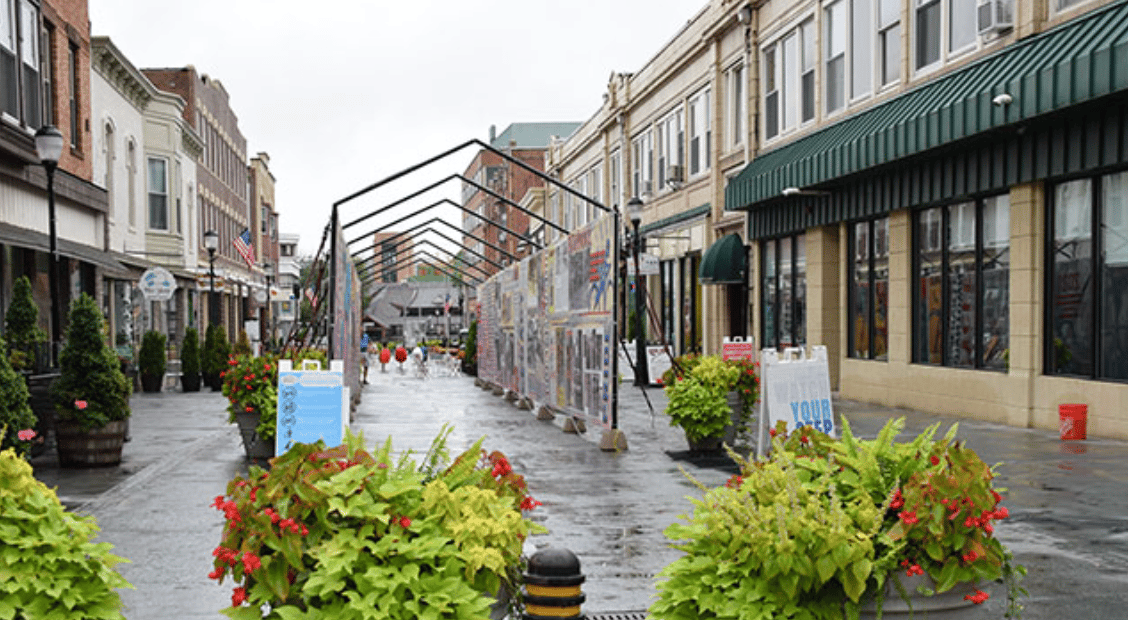
Division Street was converted into a pedestrian-focused plaza - a community gathering space that revived an underutilized side street. Outdoor dining, events, live music stage, and a nightlife feel. This changed what Somerville is: not just a place people live, but a place people go out.
Restaurants and Dining
Downtown Somerville now boasts over 50 restaurants and eateries featuring flavors from around the world - Korean, Japanese, Thai-French fusion, Greek, Filipino, Indian, South American, Italian, Cuban, American, Mexican. The density and variety is significant.
* Wolfgang's Steakhouse - ground floor of The Edge at Main
* Verve Restaurant & Landmark Bar, 18 East Main Street - French-American bistro, described as "the town's nerve center," inventive cocktails, ornate tiled floor and dark wood bar
Shopping and Retail
Over 70 specialty stores including art galleries, antiques, apparel, accessories. VintEdge wine shop at The Edge at Main. Pinot's Palette paint-and-sip studio. YESTERcades featuring classic pinball and video games. Mix of local boutiques and walkable Main Street shopping.
Events - What Keeps the Town Active
Friday Night Cruise Nights
Running since the 1980s, this is billed as the largest cruise night on the East Coast. Every Friday from Memorial Day to Labor Day, 6-9 pm, Main Street is lined with over 100 classic cars, muscle cars, street rods, and motorcycles. Thousands attend. Live music on select First Fridays on the Division Street stage. This is not a small town car show - it is a regional draw with festival atmosphere, shopping, and dining.
Summer Stage Concert Series
Free Saturday night concerts in July and August on Division Street. Regional and local talent featuring jazz, blues, reggae, folk, country, zydeco, bluegrass, rock. Draws audiences from greater Central Jersey.
Tour of Somerville
The oldest competitive bicycle race in the country, began in 1940. Now a three-day event with live music, races, and entertainment. The Kugler-Anderson Memorial race is the highlight.
Other Events
* Movies Under the Stars - Wednesday nights in summer, Division Street Plaza, outdoor screen
* Street fairs
* Arts on Division - public art installations, murals, including tributes to Lee Van Cleef and Raymond Brown, Cre8 Bench Project
* Holiday events and parades
Train Service:
NJ Transit Raritan Valley Line. Somerville station is located on Robeson Street, across from Division Street, one block west of South Bridge Street. Wheelchair accessible high-platform station.
* To Newark Penn Station: Approximately 50-60 minutes
* To New York Penn Station: Most trains require transfer at Newark (total ~90 minutes). Limited one-seat rides during select peak hours save 10-20 minutes.
* Parking: $5/day in parking garage on Robeson Street, or on-street metered parking on Veterans Memorial Drive ($0.25/hour)
What You Will Love:
* Walkable downtown with 50+ restaurants
* Train access to Newark and NYC
* Nightlife and social scene
* Events calendar - Cruise Nights, Summer Stage, Tour of Somerville
* New construction options near train
* Momentum and growth trajectory
* More affordable than Summit, Westfield, Montclair
What You Will Not:
* Parking pressure - especially during events and peak restaurant hours
* Ongoing construction and development
* Density and apartment buildings changing character
* Schools below state average
* Commute requires transfer or long one-seat ride
* Weekend event traffic (Cruise Nights draw thousands)
* Less historic charm than surrounding Hunterdon towns
Nearby Recreation
* Duke Farms - 2 miles, 1,000+ acre preservation with hiking and biking trails, workshops, events
* Veterans Memorial Park - along Raritan River, scenic views, walking paths, picnic areas
* Duke Island Park - just outside Somerville, hiking, fishing, nature
* Raritan River access - kayaking, fishing
Growth Reality - What Is Next
Somerville is still actively developing. Redevelopment zones continue along West Main Street and the station area. Additional parcels are under review. The town is not fully built out yet. There is still construction, still evolution, still units being added.
The continued focus is on walkability, density, and connectivity - transit-oriented future. This brings trade-offs: parking pressure, density concerns, and price increases as the town becomes more established and desirable.
The Bottom Line
Somerville is one of the few towns in this area that successfully transitioned from functional to intentional to desirable. It is not just a nice town anymore. It is a designed environment built around housing, transit, and lifestyle.
This is not a preservation story. It is a transformation story. The town built housing first, which created demand, which supported businesses, which created energy. Growth happened fast enough to change perception, not just add units.
You will pay less than Summit or Westfield but accept a longer commute with transfer.
Consider Alternatives If:
* You want charm without density (explore Clinton, Lambertville, Hunterdon towns)
* You want quiet and space (explore Readington, western Hunterdon)
* You need top-tier schools (explore Bridgewater-Raritan district)
* You want fully stabilized with no ongoing construction
* You need faster NYC commute (explore Summit, Westfield along Morris & Essex Line)
Interested in Somerville's evolving market? The difference between buying near the train station versus established neighborhoods three blocks away is significant - new construction pricing, walkability, long-term appreciation tied to development momentum. I can walk you through what each area offers and what you are actually trading.
Jennifer Stowe with Apogee Advisors specializes in residential real estate across Hunterdon, Somerset, Monmouth, Mercer, and Morris Counties in Central New Jersey.