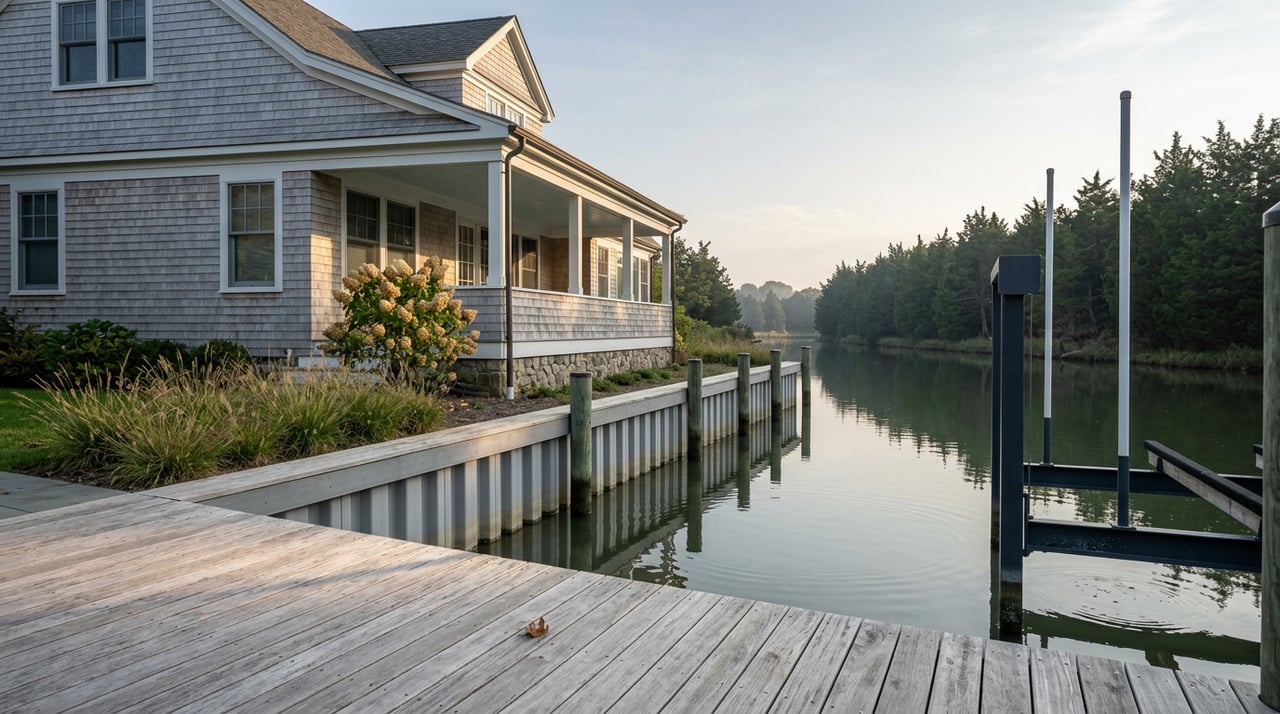
A tidelands claim can complicate a waterfront closing in Ocean County. The New Jersey Department of Environmental Protection says the state claims ownership of land that was once flowed by the tide, even if that water disappeared decades before the house was built, and that claim can sit quietly on a title until a buyer's attorney finds it two weeks before closing.
If you're getting ready to list a lagoon home in Forked River or put an offer in on a bayfront property in Barnegat, this is the piece of the transaction that generic advice skips. It doesn't come up on a home inspection. It doesn't show up in a listing photo. It shows up in a title search, and by then the clock is already running.
The State Still Owns Part of the Yard
Under New Jersey law, tidelands can affect waterfront property ownership. Barnegat Bay is a textbook example of a naturally tidal body of water.
Here's the part that surprises most owners: the claim doesn't disappear when the water does. If a lagoon was cut, filled, or rerouted at some point in the last century, and a historic map or aerial photo shows tidal flow once passed through that spot, the state can still assert an ownership interest in that strip of land today. The house doesn't need to be new. The claim can outlast the family that built it, the family that bought it from them, and the one after that.
This is what real estate attorneys call a cloud on title. It exists whether or not the current owner has ever heard of it.
Where Tidelands Claims Occur in Ocean County
A 2026 presentation from Stewart Title Guaranty Company states that tidelands claims exist in 17 of New Jersey's 21 counties. The only four exempt are the elevated, landlocked counties in the northwest: Hunterdon, Morris, Sussex, and Warren. Ocean County isn't just on that list, it's built around the exact geography that generates these claims. The lagoon communities that make towns like Beach Haven West, Forked River, Barnegat Township, and parts of Toms River and Brick so desirable for boaters were largely carved out of what were once natural tidal marshes and creeks.
That's the trade the water gives you. The same canals that put a boat lift in your backyard are the reason a title search on that backyard takes longer than it would three blocks inland.
Here's how the instruments break down:
| Instrument | What It Resolves | Typical Use Case | Rough Timeline |
|---|---|---|---|
| Riparian Grant | Permanent deed transferring formerly-flowed tidelands to the owner | Filled land that no longer carries water, most common fix for a title claim | The New Jersey Department of Environmental Protection's application instructions estimate about a year |
| Tidelands License | Short-term rental agreement to use currently-flowed state land | Docks, bulkheads, boat lifts on land still under tide | |
| Tidelands Lease | Long-term rental agreement | Homes built over currently-flowed water, larger structures | Longer term, still a rental |
| Statement of No Interest | State confirms it has no claim to the parcel | Used when a claim shows on the map but doesn't actually apply | Davison Eastman Muñoz Paone, P.A. says an applicant must prove beyond all doubt that the State has no tidelands claim to the parcel |
None of these are quick.
How Tidelands Processing Can Affect a Closing
Here's where the real friction lives. As of July 2026, the average home value across Ocean County stood at $552,498, up 4.7 percent over the prior year, with homes going to pending in roughly 25 days. That's a fast market. A seller who prices well and shows well can have an accepted offer inside a month.
A Riparian Grant, by contrast, takes about a year to process once submitted. That difference between a 25-day pending period and an approximately year-long application process can make advance planning important. A claim discovered after an offer is accepted may leave less time to address it than one identified before listing.
A seller who learns of a claim during attorney review may have less time to address it than a seller who began a grant application before listing.
Tidelands Information in Listings
Buyers on the water have started asking about this before anyone tells them to. Scan listings for lagoon and bayfront homes across Ocean County's shore towns and you'll notice a pattern: alongside the vinyl bulkhead and the boat lift specs, some sellers now note a deeded riparian grant or a dock covered by a current riparian license. In Harvey Cedars, one recent listing for a bay-frontage lot specifically flagged the dock's riparian license as a selling point, right next to the bulkhead height and lot orientation.
A listing that identifies a dock's riparian license makes that information available to buyers and their attorneys. Tidelands documents are one detail buyers can consider alongside other property information.
The Sequence That Keeps a Deal on Track
If you're planning to sell a waterfront home anywhere in Ocean County's lagoon or bay corridor, consider ordering a tidelands search before you list. If the search comes back clear, you'll have that information before marketing the home. If it comes back with a claim, you can explore a Riparian Grant application while the home is being prepared for market, rather than waiting until a sale is underway.
If you're the one buying, ask your attorney whether a tidelands search has been run and what it found, the same way you'd ask about a survey or a certificate of occupancy. A bulkhead and a dock tell you what the water access looks like. They don't tell you whether the title underneath them is clean.
This is one title issue worth reviewing before you sign anything, and it's the sort of detail a local advisor can walk through with you.
A Few Questions Worth Asking Before You List or Offer
Does every waterfront home in Ocean County have a tidelands claim? No. Many lagoon and bayfront properties have already had the issue resolved by a prior owner, or never carried a claim to begin with. The only way to know for a specific property is to run the search.
Is a tidelands claim the same thing as a flood zone designation? No, and they're handled by entirely different systems. A tidelands claim is a title and ownership question managed through New Jersey's Bureau of Tidelands Management. Flood zone status is a separate insurance and building consideration. A property can be clear of one and still need attention on the other, so don't assume resolving one settles the other.
Can a claim exist even if a family has owned the home for generations? Yes. New Jersey law does not treat long-term ownership or years of paying property taxes on the land as a substitute for the state releasing its claim. A parcel can carry an unresolved tidelands claim for decades without anyone in the family realizing it until a sale triggers a title search.
Ocean County's water is the reason people want to live here. Tidelands records are one title detail to consider when buying or selling waterfront property. If you're weighing a sale on a lagoon in Forked River, a bayfront lot in Barnegat, or anything with a dock attached to it anywhere between Toms River and Long Beach Island, Apogee Real Estate Advisors can walk you through the title picture as you consider your options. Let's talk about your next move.
This article is general information, not legal, tax or financial advice. Consult a qualified professional about your situation.