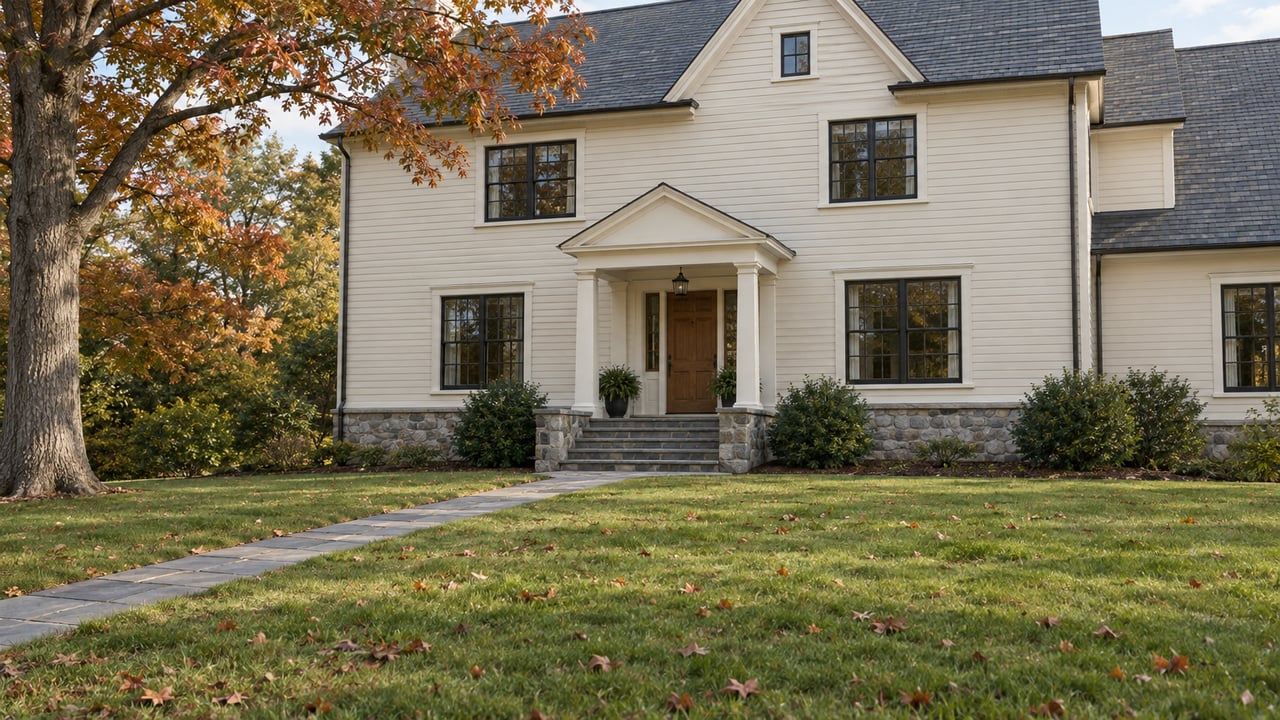
For decades, the Educational Testing Service campus in Lawrence Township was where the SAT and other standardized tests got built, scored and normed for schools across the country. MercerMe reports that the ETS property is on the township's list of sites for its affordable housing compliance plan, but that no formal application has been filed and the zoning framework establishes what could be built, not what will be built. Local reporting this year has pointed to a potential 800-unit development on the ETS site.
That distinction matters, but so does the fact that Lawrence didn't stumble into this. The township put ETS on the list on purpose. Across Mercer County this year, towns are working through the same math: where to put new housing so a court doesn't decide it for them. If you're comparing Princeton to West Windsor to Lawrence to Hopewell right now, the number that tells you the most isn't the sale price you've already seen on a portal. It's which parcel each town chose.
Why every town in Mercer County is doing this math at once
In March 2024, Governor Murphy signed P.L. 2024, c.2, a law that rewrote how New Jersey enforces its decades-old constitutional obligation to plan for affordable housing. The old system ran through the Council on Affordable Housing, an agency that had been effectively dormant for years. The new one runs through the state Department of Community Affairs and a court-supervised dispute resolution program, with binding numbers, adopted plans and a hard deadline for the current cycle, known as the Fourth Round, covering 2025 through 2035.
Miss the deadline and a town loses something specific: immunity from what's called a builder's remedy lawsuit. That's not an abstraction in Mercer County. Community News reported that in 2002, West Windsor lost a builder's remedy case to Toll Brothers after a court found the township had engaged in exclusionary zoning. The result was court-ordered zoning that became the 1,165-unit Estates at Princeton Junction, a development the township didn't design and couldn't easily shape. That history is the reason 2026 looks the way it does. Towns that adopt a certified plan on time keep the pen. Towns that don't hand it to a judge.
The deadline that's setting the sequence
The Town of Princeton announced that Superior Court Judge Robert Lougy approved the borough's Fourth Round settlement in February 2026, consolidating the borough's prior unmet need and its new prospective obligation into a single framework worth 364 credits. The court's order required Princeton to adopt implementing ordinances by March 15, 2026, or risk losing that immunity for the entire cycle. Municipal planner Justin Lesko said the decision was straightforward: "We are fully prepared to adopt the implementing ordinances necessary to secure final certification."
West Windsor was moving under a comparable settlement deadline. The township has a fourth-round obligation. The plan the planning board adopted in early February 2026 spreads that obligation across eight sites. On March 30, 2026, the council adopted Ordinance 2026-11, updating its zoning and subdivision rules to lock in that plan, with one council member noting the ordinance requires that every bedroom have a window.
MercerMe reports that Hopewell Township is carrying a fourth-round obligation of close to 400 units, on top of a long-running prior obligation that produced The Venue, an age-restricted development on Scotch Road that finished its approval process in 2025. The Local Lens reported that Lawrence's numbers moved through more than one round: a third-round obligation with 408 identified as unmet need, and a fourth-round figure the state calculated at 320 units.
Where the obligation actually lands
The pattern across all four towns is the same. Nobody is upzoning a block of existing single-family homes. Everybody is reaching for the largest, most legally defensible non-residential parcel available: a corporate campus, an office park, a shopping center.
| Town | Fourth Round Obligation | Where It's Landing |
|---|---|---|
| Princeton | 364 credits (combined prior and fourth round) | Settlement finalized February 2026; specific sites tied to the certified plan |
| West Windsor | Fourth-round obligation | Citizen Portal identifies the BMS site (Route 1/Nassau Park Blvd), Carnegie Center/BXP, Woodmont, Oboz La Placa, and a K. Hovnanian parcel near Princeton Junction as sites in the plan. |
| Lawrence Township | 320 units (fourth round), plus 408 unmet need carried from the third round | ETS campus, Quaker Bridge Mall, Lawrence Shopping Center, Princess Road parcels |
| Hopewell Township | Approximately 400 units | Weidel tract, Pennytown site, a TCNJ-associated parcel near I-295 |
The West Windsor list is the clearest example of the strategy. The former Bristol-Myers Squibb site at Route 1 and Nassau Park Boulevard is being rezoned for roughly 650 total units. The Carnegie Center office complex, long the township's commercial anchor, is picking up two new zoning districts under the BXP redevelopment. A Tractor Supply-anchored commercial site is slated for about 216 units. A parcel tied to K. Hovnanian near the train station is also part of the plan.
Lawrence's list works the same way without the office-park scale: the Lawrence Shopping Center and Princess Road properties were already zoned to cover the township's unmet need, while the Quaker Bridge Mall site sits appropriately zoned but still waiting on further approvals. One Lawrence Township official, identified in MercerMe's meeting coverage only as Bobbitt, put the logic plainly: "You have to allow for the opportunity for something to happen. You can't just zone everything as open space and say nothing's going to be built." The goal, as officials framed it, is meeting the state's numbers while keeping as much local control over the outcome as possible.
What this means if you're comparing towns
A median price tells you what closed last month. It doesn't tell you what's coming. In Mercer County right now, the Fourth Round site list is a better predictor of where construction, traffic patterns and the local housing mix will shift over the next several years, because it's the one document each town has already committed to in front of a judge.
If you're weighing a home near the Carnegie Center in West Windsor, near Quaker Bridge Mall in Lawrence, or along Route 31 in Hopewell, the relevant question isn't whether that town is "growing." All four are, by design. The relevant question is whether the specific site is one the town chose because it can absorb density without touching adjacent single-family blocks, or whether it's still contested. A property near the ETS campus in Lawrence sits near a site with a designated capacity of up to 800 units and no filed application yet. A property near the Estates at Princeton Junction in West Windsor sits near a development that a judge, not the township, ultimately shaped two decades ago. Those are different kinds of proximity, and they carry different kinds of uncertainty.
A few questions worth asking before you tour in these towns
Has a formal development application been filed, or is the zoning still just a designation? Lawrence Township officials were explicit that the ETS site framework establishes what could be built, not what will be built. That gap can run for years.
Mercer County's housing math for the next decade is already written down, town by town, parcel by parcel. It's public, it's dated, and it says more about what a neighborhood will look like in five years than any chart of past sales ever will.
If you're weighing a move within Mercer County and want a read on what a specific town's compliance plan means for a specific street, Jennifer Stowe at Apogee Real Estate Advisors can walk through it with you. Let's talk about your next move.
This article is general information, not legal, tax or financial advice. Consult a qualified professional about your situation.