Princeton's luxury homes stand apart through a rare combination of late-19th-century architectural heritage, 20 historically designated districts, a world-class institutional ecosystem anchored by Princeton University, and walkable access to cultural amenities that simply don't exist elsewhere in Central New Jersey.
What sets Princeton's luxury homes apart from other Central New Jersey properties?
Princeton's luxury homes apart from the rest of Central New Jersey through a combination that's genuinely hard to replicate: late-19th-century architectural heritage concentrated on streets like Dickinson Street, University Place, and Bayard Lane; 20 historically designated districts; and a walkable, institutionally anchored lifestyle built around Princeton University, the Institute for Advanced Study, and a dense network of cultural venues. No other town in this region offers all three at once.
Key Takeaways
- Princeton has 20 historically designated districts, a concentration of protected architectural heritage that is rare anywhere in Central New Jersey.
- Princeton's median household income was $184,113 (2019–2023 estimate), reflecting the substantial purchasing power that underpins its high-end residential market.
- Historic-district status in Princeton can affect exterior alterations, additions, and demolition, buyers of estate properties need to understand these rules before planning renovations.
- The institutional ecosystem, Princeton University, the Institute for Advanced Study, the Hun School, Princeton Day School, and Stuart Country Day School, creates a consistent draw for relocation buyers that few markets can match.
- Luxury buyers should evaluate a Princeton property on architectural integrity, historic-district standing, and lifestyle proximity, not square footage alone.
Why does Princeton's architecture make its luxury homes different?
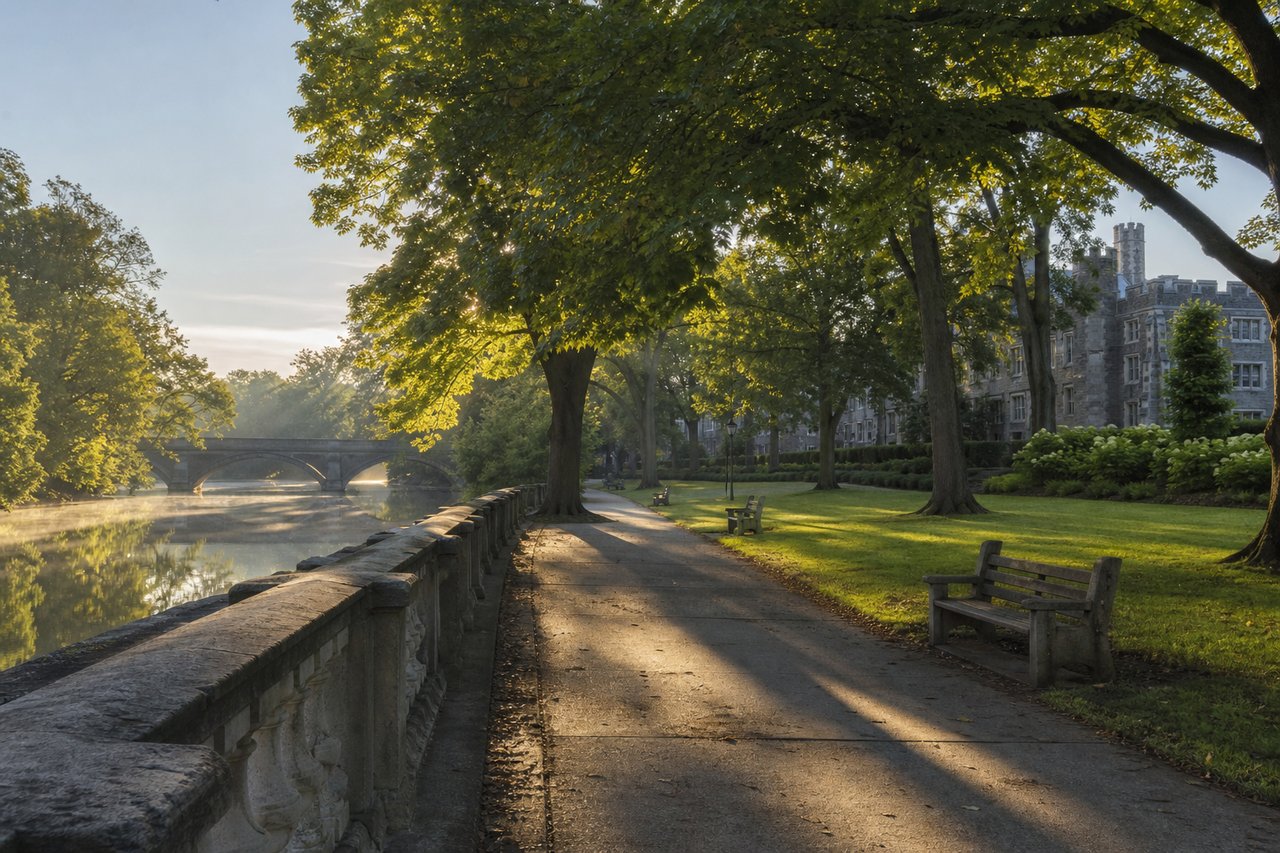
The short answer: the bones here are irreplaceable. Princeton's concentration of late-19th-century estates on Dickinson Street, University Place, and Bayard Lane represents a scale and continuity of historic residential architecture you simply won't find in newer suburban communities across Central New Jersey.
That's what makes Princeton's luxury homes apart from the broader market. In most towns, a "luxury home" means a large new construction with high-end finishes. In Princeton, it can mean a fully restored Victorian or Colonial Revival with original millwork, slate roofs, and mature landscaping on a lot that's been in continuous residential use for over a century.
The tradeoff is real, though. With 20 historically designated districts across the municipality, a significant share of Princeton's most desirable properties carry historic-preservation obligations. Exterior alterations, additions, and in some cases demolition require review and approval under the applicable district rules. I walk every buyer through this before we even make an offer, knowing what you can and can't change is fundamental to evaluating a historic estate, not an afterthought.
What does historic-district status mean for a buyer practically?
It means your renovation plans need to account for the Princeton Historic Preservation Commission's review process before you commit to a purchase price. The specific rules depend on the district and the scope of work. If you're buying a property with plans to expand, modernize the exterior, or add outbuildings, you'll want to understand the approval process as part of your due diligence, not after closing. This is exactly the kind of conversation I have with buyers early, because it shapes what a property is actually worth to them.
For a deeper look at how historic character compares to new construction in NJ markets, the Relocating to Princeton, NJ: A Local Guide covers the full picture for buyers coming in from outside the area.
Feature | Princeton Historic Estates | Typical Central NJ Luxury New Construction |
|---|---|---|
Architectural character | Late-19th/early-20th century; original millwork, slate, masonry | Contemporary finishes; builder-grade luxury packages |
Lot maturity | Established landscapes, mature trees, defined streetscapes | Recently graded; landscaping grows in over years |
Renovation flexibility | May require Historic Preservation Commission review | Generally unrestricted (subject to zoning) |
Supply constraint | Fixed, no new historic inventory can be created | Expandable through new development |
Institutional proximity | Walking distance to Princeton University campus and downtown | Varies widely by location |
What lifestyle and institutional factors drive Princeton's luxury market?
Princeton's luxury market is sustained by a draw that goes well beyond the physical homes. The Municipality of Princeton identifies Princeton University, the Institute for Advanced Study, the Hun School, Princeton Day School, and Stuart Country Day School as institutions located within the town's borders. That institutional density creates a consistent, self-renewing pool of buyers, faculty, researchers, executives, and families drawn here specifically for what Princeton offers that no other Central New Jersey town does.
According to the U.S. Census Bureau, Princeton's population was estimated at 31,445 in July 2024, up 2.5% from the 2020 census, a steady, stable residential base. And the median household income of $184,113 (2019–2023) reflects the purchasing power that keeps the high end of this market active.
On the lifestyle side, Experience Princeton documents what residents actually have access to: Morven Museum and Garden, the Princeton Garden Theatre, the Arts Council of Princeton, Drumthwacket, Institute Woods, and the Delaware and Raritan Canal State Park Trail. That's a walkable combination of arts, history, and green space that most suburban communities in this region simply can't match.
For buyers considering a move up into this market, my Luxury Move-Up Homes in Central NJ: A Buyer's Guide lays out what to evaluate when you're ready to make that step.
Is Princeton's location a factor in its luxury appeal?
It's a significant one. Princeton sits roughly 50 minutes from both New York City and Philadelphia, and about 45 minutes from the Jersey Shore. For buyers who need access to two major metro markets, or who are relocating from one of them, that geography is genuinely rare. You get a self-contained, walkable college town with its own cultural infrastructure, and you're not sacrificing commute options to have it.
Relocation buyers, in particular, respond to this. I work with clients coming from Manhattan, Philadelphia, and internationally, and Princeton consistently comes up as a destination precisely because it doesn't feel like a compromise, it feels like an upgrade. What features actually command premium prices in markets like this is worth understanding before you list or buy; the specifics matter more than the general reputation.
Frequently Asked Questions
What makes Princeton luxury homes different from other Central New Jersey properties?
Princeton's luxury homes combine a concentration of protected historic architecture, 20 historically designated districts, and an institutional ecosystem anchored by Princeton University and the Institute for Advanced Study, none of which exist at this scale elsewhere in Central New Jersey. The supply of genuine historic estates here is fixed, which creates a market dynamic distinct from newer luxury communities in Somerset or Hunterdon counties.
Which Princeton streets and areas are known for historic estates and distinctive architecture?
Princeton's official historic-preservation materials identify Dickinson Street, University Place, and Bayard Lane as concentrations of large late-19th-century homes. These streets sit within or near the town's historically designated districts and represent some of the most architecturally significant residential inventory in Central New Jersey. A local agent who knows these blocks specifically, not just the town generally, makes a real difference in evaluating what you're buying.
How do Princeton's historic-district rules affect renovations and additions?
Properties within Princeton's 20 historically designated districts may require review by the Historic Preservation Commission before exterior alterations, additions, or demolition can proceed. The specific requirements depend on the district and the scope of the proposed work. Buyers planning significant changes should factor the review process into their timeline and budget before closing, not after. I always recommend addressing this in due diligence.
Are Princeton luxury homes a good long-term investment?
Princeton's combination of fixed historic supply, sustained institutional demand, and a high-income residential base creates conditions that support long-term value, but no property is a guaranteed return, and actual outcomes depend on the specific home, financing terms, holding period, maintenance costs, and market conditions at the time of sale. What I can tell you is that the factors driving demand here, the University, the institutional ecosystem, the lifestyle, are durable in ways that speculative demand in other markets is not. Your specific situation deserves a real conversation, not a blog post estimate.
What should buyers look for in a Princeton estate beyond square footage?
Historic-district standing, architectural integrity, the condition of original features (millwork, roofing, masonry), and the property's specific renovation rights under applicable preservation rules matter far more than raw square footage in this market. Proximity to downtown, Institute Woods, and the University campus also affects long-term desirability in ways that don't show up in a price-per-square-foot calculation. I walk buyers through all of these before we write an offer.
Princeton's luxury market rewards buyers who understand what they're actually buying, and sellers who know how to position what they have. If you're evaluating a Princeton estate, planning to list one, or relocating to this area, I'd welcome the conversation.
Call or text me directly at 908-268-5402 and let's talk through what your next move looks like in this market.
Follow along on Instagram or watch market updates on YouTube for ongoing coverage of Princeton and Central New Jersey luxury real estate.
Equal Housing Opportunity. Jennifer Stowe, NJ License #12220869, regulated by the New Jersey Real Estate Commission (NJREC). This article is general information only and does not constitute legal, tax, or financial advice. Confirm your specific numbers with your closing agent, tax advisor, or lender. Broker fees and commissions are fully negotiable and not set by law.